The Multi-Dimensional Universal Perspective

The Universal Perspective

The Blind Men, The Elephant, and N-Dimensional Reality

The Parable of the Elephant

Originating from ancient India and found across Buddhist, Hindu, and Jain texts, the story of the Blind Men and the Elephant explains a core concept: that truth and reality are perceived differently from diverse points of view, and no single subjective point is the complete truth.

The Broad Side

"Ah," he declared, "an elephant is very much like a great, rough wall!"

The Sharp Tusk

"You are wrong. It is round, smooth, and sharp. It is exactly like a spear!"

The Squirming Trunk

"Anyone can feel this creature is long, flexible, and muscular. An elephant is like a giant snake!"

The Thick Leg

"It is firm, tall, and rooted to the ground. An elephant is clearly just like a tree trunk!"

The Flapping Ear

"Even a blind man can tell this is not a tree. It is flat, thin, and moves the air. It is like a large fan."

The Swinging Tail

"You have all lost your senses. An elephant is nothing more than a piece of frayed rope!"

The men argued fiercely, each defending his fraction of the truth. Finally, the king intervened:

"You are all right, and yet, you are all wrong. Each of you has touched only one part of the elephant. The elephant has all of those features... You are arguing because you each possess only a fraction of the truth, but you mistake your small fraction for the whole."

Perception and Truth
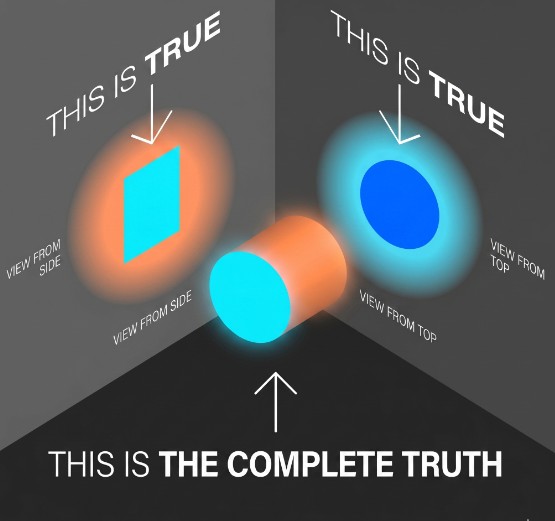
Cylinder Truth Projection Diagram

The Illusion of Absolute Certainty

Each man in the story spoke from his own direct, empirical experience. They were not lying; what they felt was real. However, they erred by assuming their subjective experience represented the objective entirety of the subject.

The story illustrates how humans often latch onto their specific cultural, religious, or personal perspectives (touching one part of the elephant) and become aggressively dogmatic, dismissing the valid experiences of others. To understand the "whole elephant," the men needed to stop arguing, listen to one another, and synthesize their distinct experiences.
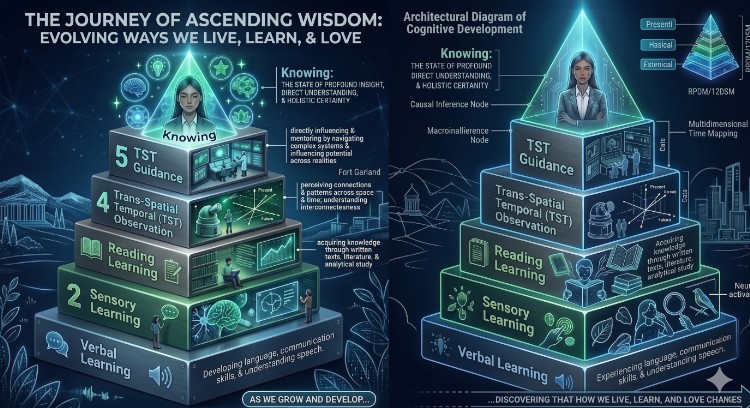
Master Wysteria on Tensor Math and Reality Assessment

"As we develop, how we live, learn, and love changes."

Citation: Master Wysteria from the We Are One Movie, 2027, Quawn Studios.

Architectural Diagram of Cognitive Development

"We have wisdom to have courage, courage to have faith, and faith that we might believe."

Cognitive Architecture

The Journey of Ascending Wisdom

As consciousness expands, the awareness radius increases, and as the awareness radius increases, the mechanisms through which we apprehend reality change with our State of Being and, eventually, our State of Existence. This progression moves beyond the basal levels of Verbal and Sensory Learning—where perception is limited to immediate physical phenomena (akin to the isolated blind men)—into deeper analytical models.


Reaching the apex of this developmental architecture requires transitioning into Trans-Spatial Temporal (TST) Observation and Guidance; while still perceptually based, this stage broadens the inclusion and awareness radii. Here, we cease merely reacting to isolated data points and begin mapping multidimensional connections across time and space. Ultimately, this journey culminates in Knowing: a state of profound, direct understanding and holistic certainty that navigates complex systems across realities.

Expanding Perception: The Radius and the Tensor

To conceptualize how individual nodes of human consciousness interact with reality, we introduce the inclusion radius and the awareness radius as geometric analogues. If the blind men had simply walked around the elephant, exploring its perimeter, they would have drawn a far more holistic conclusion. They would have "included" more sensory data, expanding their awareness proportionally.

However, while a basic geometric radius provides an intuitive starting point—imagining the blind men mapping a flat 2D plane—it remains fundamentally limited when describing profound, multidimensional reality. We must recognize that we can extrapolate this awareness downward to approaching 1D (a single, indivisible point of dogma), or upward into 4D space and beyond.

To truly navigate this multidimensional expansion of awareness across infinite variables—such as an elephant's temperature, its memory of a drought, or its social bond to the herd—we require a more sophisticated mathematical framework. Therefore, we transition from the simple geometric radius to the tensor class, capable of scaling across any number of dimensions to describe the relationships within a complex vector space.

Scalar

Rank-0 Tensor

A quantity with only magnitude (a 0D point). This represents isolated perception, the absolute minimum scale of measurement. It is the blind man holding just the tusk, his awareness radius at zero; a fixed, dogmatic point.

Vector

Rank-1 Tensor

Has both magnitude and direction. This is akin to the blind man moving his hands along the length of the trunk, gaining a linear stream of information. The awareness radius has stretched into a line.

Matrix

Rank-2 Tensor

Operates in two dimensions. The blind men exploring the perimeter of the elephant, mapping a flat plane of data and forming a wider, but still limited, 2D geometry of truth.

N-Dimensional

Higher-Rank Tensors

Moving into 3D, 4D, and beyond. The awareness radius upgrades from a single scalar point into a complex tensor capable of grasping the profound, multi-faceted reality of the "whole elephant."

"If the doors of perception were cleansed every thing would appear to man as it is, Infinite."

The Foundation

A Universal Perspective

The Universal Solution Model (USM) and the Core and Applied Volumes of this 140-plus volume reference series are based on a Universal Perspective.

Derived from decades of theoretical research and development focused on consciousness and the nature of "Mind," "How we know," and "Who we are," this effort culminated in the founding of new fields, including Neoscience and Affective Epistemology.

To implement these theoretical models, a vast technological framework—The Rational Data Industry Model (RDIM)—was established. The combined works of both academic theory and technical proof-of-concept have been formalized into the dynamic BlueBook Series. These Core Volumes address the "Big Three" and "Big Five" questions of existence, creating an operative map for realizing higher states of being and existence.

From Apprehension to Coherence

Knowing the physical outline of an object is merely an apprehension of form; it falls radically short of comprehending behavior and intent. To connect isolated points of understanding—to predict how the elephant behaves—requires a vastly expanded inclusion radius from which we develop coherence.

The Dimensions Class

As we expand into n-dimensional reality, we must strictly define our terms across the Dimensions Class to process both the physical constraints and the subjective, abstract potentials of the system.

Physical Dimensions
(L, M, T, Θ) The measurable properties of the material universe (Length, Mass, Time, Temperature). This is what the blind men were grasping at—the physical geometry. They are objective, universal constraints independent of human units.
Trans-Spatial-Temporal
Plotting the elephant's anger, its memory of a drought, or its social bond. These represent layers of reality—states of consciousness and subjective experience—that transcend 4D spacetime. They cannot be quantified by a physical ruler, yet are vital for predictive coherence.
AI / Vector Dimensions
A single coordinate axis in an abstract vector space (e.g., a 768-dimensional embedding). Working collectively, they allow a computational model to semantically encode both the physical "weight" of the elephant and the abstract "sentiment" of its emotion into a unified mathematical space.

The Framework for Coherence

Understanding the fundamental difference between these three dimension types—the measurable physical, the non-palpable subjective, and the abstract informational mapping—provides the required structure to build a fully coherent model. With this definitional clarity resting on the substrate of Zero Principles, we are ready to view the elephant not as a fragmented physical object, but as an infinite pattern.

The Challenge of Measurement

Yet, we must pause here and acknowledge a profound challenge. While the preceding framework provides definitional clarity, we still face a fundamental difficulty: it is one thing to map the physical realm. This process seems straightforward enough; scientists have been measuring the physical universe for millennia—calculating the exact distance between Point A and Point B—and while we might argue exceptions at the quantum scale, this classical physical mapping remains highly reliable. However, when we transition to mapping the seemingly unquantifiable—states of consciousness, emotional resonance, or subjective experience—how do we actually plot these coordinates? Even within the cutting-edge fields of artificial intelligence, the exact mechanisms of symbolic mapping and the true mathematical representation of abstract meaning remain fiercely contested.

A Hierarchical Taxonomy of Truth

To resolve this challenge, we employ a hierarchical taxonomy of truth: beginning with Zero Principles, ascending to First Principles, and progressing outward into subsequent axiomatic layers. These principles do not merely describe reality; they constitute the fundamental ontological scaffolding that frames existence itself. From this architecture, we derive a rigorous, empirical process for mapping multi-dimensional information. In subsequent sections, we will delve deeply into the mechanics and rationale of this methodology, delineating exactly how it diverges from—and expands upon—contemporary paradigms in artificial intelligence, machine learning, and traditional epistemological models. Furthermore, we will draw explicit parallels between this conceptual framework and the mathematical models employed to describe it. We will articulate the rationale behind our selection of these specific methods, accompanied by a crucial caveat: these mathematical structures are tools. While not infallible in their absolute conception, they function much like our earlier analogy of the radius—serving a specific, highly effective capacity in the expansion of our comprehension.

Thought Mapping & Vector Space

By plotting emotional resonance and subjective/objective experience into high-dimensional vector space, we create a quantifiable topology of thought. This visualization demonstrates how abstract metrics can be systematically encoded, revealing the underlying geometric architecture of what was previously deemed unquantifiable.

[Live Vector Translation]

Ref. BON: Within a model postulating a Universal Consciousness Field (UCF)—where consciousness becomes mutually accessible across multiple observers under specific boundary conditions—the traditionally subjective experience is fundamentally transmuted into an objective reality.

The Substrate of Consciousness

Before we jump into the Universal Perspective and explore what N-Dimensionality actually means—both in the context of contemporary AI models and, more specifically, within the Neoscientific Model and Frameworks—we must acknowledge a foundational premise. This goes back to the idea that one of the foundational substrate layers of reality is consciousness itself. Within that consciousness is the idea of thought-form, and with thought-form is the concept of homeostatically and otherwise directed energy.

At this juncture, it is imperative to note that the principles and conceptual frameworks introduced thus far provide the essential scaffolding required to understand both human consciousness and artificial intelligence. As this text progresses, we will systematically articulate the structural parallels and fundamental divergences between these two modes of processing. Furthermore, we will demonstrate how these foundational understandings serve as the architecture for two parallel layers within the Planetary Semantic Layer (PSL). This semantic framework acts as a critical component of the broader Planetary Operating System (POS), which itself operates within the Planetary Solution Model (PSM) to ultimately underpin both the Planetary Governance Model (PGM) and the Planetary Management System (PMS).

The Universal Perspective: State Space and N-Dimensionality

Imagine a visual representation of a sphere, not just existing in three physical dimensions, but radiating outward into countless axes—each representing a different variable of existence. This is the realm of state space. In physics and mathematics, a state space is a conceptual arena where every possible state of a system is represented as a unique point.

When we apply this to our elephant, we are no longer just mapping its physical height, width, and depth (a 3D matrix). We are adding dimensions for its temperature, its heart rate, its memory, its velocity, its emotional state, and its trajectory through time. As we add these variables, we enter n-dimensionality—a space of n dimensions, where n can be any number required to fully describe the system's potential and actualized states.

Achieving a Universal Perspective requires us to view reality through this n-dimensional lens. From the perspective of Universal Mind, a conscious node (like a human, or even an elephant, or a Dolphin) is not merely a biological object moving through 3D space; it is a dynamic trajectory moving through an infinitely complex state space. Every thought, action, and interaction shifts its coordinates within this grand, multidimensional architecture. This brings us the Nth-Dimensional Universe (NDU).

The Holographic Universe

If we view this newly understood n-dimensional state space through the lens of a Holographic Universe, the single Rank-0 scalar point (the grain of sand) is not isolated. It mathematically encodes the architecture of the entire Universal Mind.

To expand our awareness radius is to realize the code for the entire elephant—and the universe it inhabits—is already written within, or fundamentally connected to, the very point from which we observe.

Auguries of Innocence

"To see a World in a Grain of Sand
And a Heaven in a Wild Flower
Hold Infinity in the palm of your hand
And Eternity in an hour."

— William Blake

The Territory Made Manifest

The Nth Dimension Universe (NDU)

This brings us to the Nth Dimension Universe (NDU)—the fully interactive, and immersive metaverse of multi-dimensional human actualization.


If the Book of Neoscience provides the map, and the I2DSM provides the engine, the NDU is the territory made manifest. The Nth Dimension Universe represents the unparalleled spatial-temporal rendering of the Planetary Semantic Layer and the Trans-Spatial-Temporal (Type 4) dimensions.


Far exceeding the primitive concepts of corporate virtual reality or entertainment-based metaverses, the NDU is an Ontological Reality Engine designed for profound experiential learning, governance, and collective evolution. Advanced Navigation of both Universal Mind and Information Space is powered by the Nexus Anulus Navigator (NAN).